
JANUARY 2025
Mindmaps are a great visual method and easy tool for early childhood educators and teachers to use to display the children’s long-term learning journey or journeys. I personally love mindmaps, and have received positive feedback about my use of them from parents, other educators, and even the department upon one of their visits. Mindmaps marry well with the emergent style of early years curriculum, which many educators and teachers implement.
So what does it look like? A mindmap can be small or large. It can take up an entire wall space or a single page of a project book. It may be accompanied by photos or contain text only. It may include links similar to a programming document (e.g. links to EYLF outcomes, observation extensions and service philosophy) or it may detail the phases of the learning journey only. Personally, I prefer to use a large project book or to tape three or four A3 sheets to the wall in a long poster fashion, stretching across the wall long ways, displayed somewhere nearby the parent communication wall or board. I detail the phases of the learning journey, write the date it took place, and list the initials of the children involved in the experience.
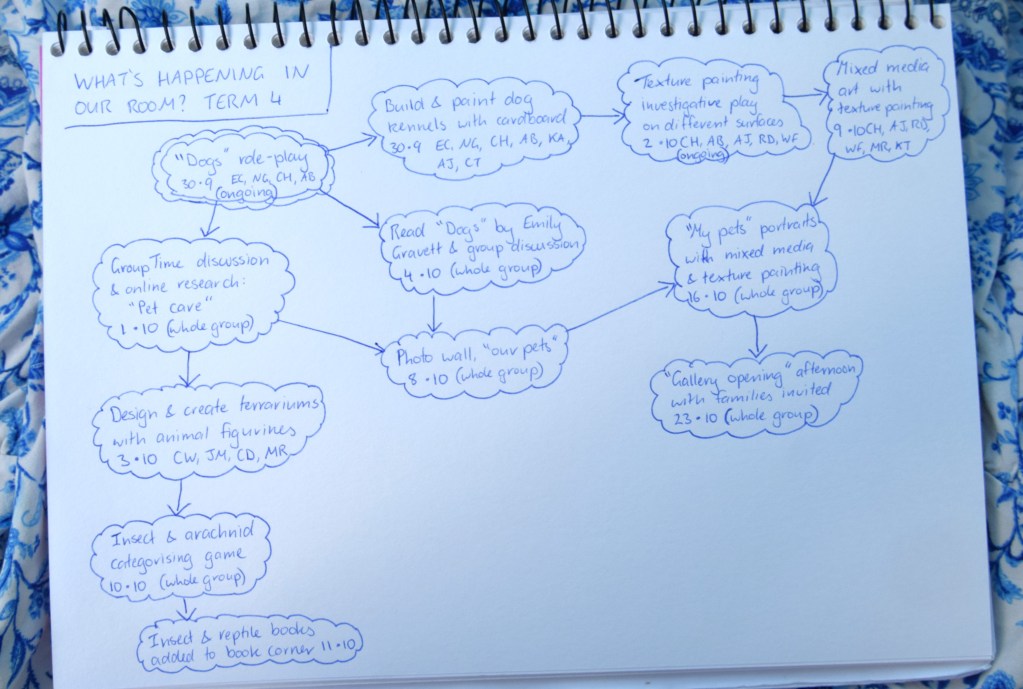
The “map” layout is made up of bubbles of text that detail a phase of a learning journey, connected to other bubbles that detail further learning, extensions or follow up experiences. These bubbles are connected with arrows to display to the reader the “direction” of the learning, or what learning phase has lead to another.
How do we use it? This is dependent upon the individual educator or teacher and how they choose to use it. Personally, I typically use one mindmap per term. I only include major events in the cohort’s learning journey on the mindmap. This is because there is little room on the paper I use, and I wish to only focus on major events that small and large groups have participated in, that are meaningful to the overall learning journey of the cohort. In the past, I have included too much on my mindmaps, resulting is a very messy presentation which becomes confusing and overwhelming for others and even myself to read! I always use a mindmap alongside my written program. This way, my mindmap remains succinct and neat, and my program contains all the other necessary details that take up a lot of written room. This may seem like doubling up, but in reality, I spend less than five minutes a week actually writing on the mindmap.

How often do we use it? I record phases of the children’s learning journey that seem significant and lead to further learning, simply as they present themselves. This may be once, twice, or five times a week. I then record any learning extensions or follow up experiences on the mindmap also, which results in the “map” look of the document. I have seen other educators and teachers record more often, resulting in “busier” maps, to which their solution is to simply create new maps more frequently. This may work for some, but I find that concepts I’m revisiting with the children over a number of weeks are easier to read and follow on the one comprehensive map.
Why do we use it? The mindmap is a wonderfully visual document that beautifully and concisely captures and displays the children’s learning journey. For parents, other staff and visitors to the classroom, it is a visually appealing and easy-to-read document that helps the reader understand the learning that is currently happening. Children can become involved in the process too – I once watched one teacher cover an entire wall in butcher’s paper, to which she added phases of the learning journey in the form of a mindmap, included written notes from children’s input, and the children even added their own drawings to depict and reflect upon their own learning journey.

Mindmaps allow for plenty of “play room” and flexibility depending on how the educator or teacher wishes to use them. I encourage you to trial it for yourself. You may wish to design private mindmaps that you do not yet display, until you are comfortable and confident with the process. If you have been disheartened or disappointed by the process in the past, I encourage you to try again, to do further research on mindmaps and equip yourself with greater knowledge and advice from other educators and teachers. Mindmaps are a beautiful addition to the documentation of the early years’ learning environment. Wishing you all the best on your mindmap journey!
Leave a Reply