
APRIL 2025

There is a lot of research available, that presents evidence for the importance of physical touch and its impact on children’s brain development in early childhood, especially in the period from birth to five years of age. I encourage you to research this for yourself if you are interested. The research findings typically present that children who receive appropriate physical touch tend to have better, more healthy brain development, and those that lack physical touch from their loved ones tend to miss out on optimal brain development.
As children are typically with us in the early years setting for a large part of the day (realistically, a large part of their childhood), it is important to incorporate this basic human need into our interactions with the children and within our early years program. Additionally, I have noticed myself, the immediate benefits for children, such as calming emotions, gently redirecting focus, and mood boosting effects of physical touch. I’m going to present some examples of appropriate physical touch between educators and children that I have with my kindergarten or preschool children.
- Hugs. Hugs, or just being held, are one of the most common forms of physical touch that young children seek from adults. Children may seek a hug upon arrival when they are excited to see me, they may seek a hug when they are upset or hurt and are seeking comfort, and they may seek a hug when sitting together to play or read a book. I always ensure I am hugging children appropriately by being gentle, I try to get down to their level to hug if possible and I am always touching them in an appropriate and safe area such as the flat of the back or the shoulders.
- High fives. Some children do not like to be touched at all, and I always respect this. This could be due to a sensory issue, a social concern, a matter of trust, or a traumatic past event that the child has been through. If a child does not wish to touch or be touched, I do my best to ensure our relationship remains positive with plenty of positive verbal interactions instead. For those children who are comfortable enough, one easy way to make physical touch a quick, predictable and comfortable interaction is to give a high five. Most children love high fives and respond enthusiastically, sometimes a little too enthusiastically. I like to encourage high fives when greeting children of a morning as they enter through the doorway, during physical games outdoors, perhaps as I’m doing roll call and inviting children up to give me a high five when their name is called, or as a way of transitioning between stages of our routine such as handwashing before meal times.
- Hand holding. Children often seek to hold hands as another means of comfort and security. I often invite children to hold my hand for a little while if they have had a difficult time when separating from their parents of a morning. I may sit with them or walk around with them, holding their hand, until they feel comfortable enough to engage in play of their own accord. Two things I am mindful of when hand holding, is not to hold children’s hands for too long, as I would prefer them to be playing and learning as soon as they are comfortable enough to do so. Also, I only have two hands and many children. I establish my expectations early in the school year for hand holding, so that I do not have multiple children fighting to hold my hand at once. It does happen!
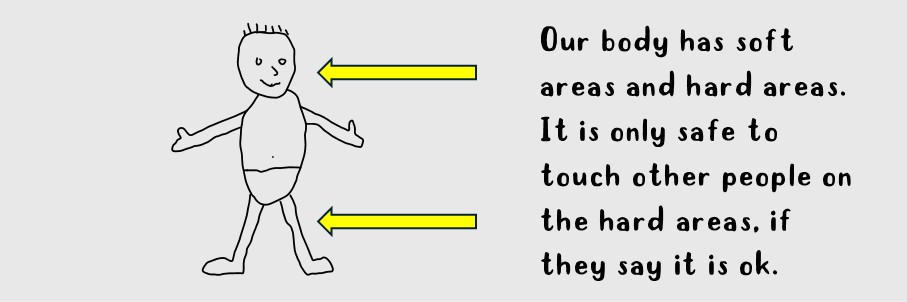
- Appropriate physical touching between children. Human touch is part of human behaviour, especially among children. There are many benefits to physical touch and physical play among children, such as sensory awareness, spatial awareness, schema exploration, emotional wellbeing, and of course, brain development. I usually set expectations early in the school year in regard to what is and what isn’t appropriate physical touching. I usually start off with a group discussion about the topic and draw a large image of a clothed body on the whiteboard as a visual aid to accompany the discussion. I talk about the soft areas and hard areas of the body. When speaking about the “hard” areas of the body, I list the hands, arms, feet and legs for the children. The children are encouraged to feel these harder areas of their own bodies. We then reflect as a group how it is ok to touch people on these areas of their body if we are playing, and if it is ok with them. We talk about how these harder areas of the body are generally safer places to touch others. I then list the “soft” areas of the body, such as the face, neck, torso and groin area, and children are encouraged to feel how soft their face, neck and torso are. We speak about why it is important to protect these softer areas of the body, including their important functions, and why it is not ok for someone else to touch you in these areas, unless they are a trusted adult that is helping you with something. Whenever social issues arise, such as rough play, inappropriate behaviours in the bathroom, or other inappropriate play, I refer to this discussion along with it’s visual aid of the human body. Learning what is and is not acceptable social behaviour, including physical touch, takes time, lots of revisiting and explicit teaching for young children.
- Inappropriate touching. I have witnessed educators, usually young and inexperienced educators with good intentions, share inappropriate touching with the children. With a little guidance, they have been able to gain a perspective of what might or might not be appropriate, and alter their interactions with the children. Some examples of inappropriate touching are tickling games with children who demonstrate body language that indicates they do not wish to be tickled, rough play, piggy back riding, allowing children to climb on the educator’s back and shoulders while sitting on the carpet, holding children’s faces to speak to them, grabbing children by the shirt when guiding their behaviour, playing “aeroplanes” by holding children by their arms and swinging them around, and introducing sporting moves which are not age appropriate. With each of these instances, you can see that there are alternative ways to physically touch and interact with the children, or the physical touch should be omitted completely and the situation dealt with in a more respectful manner. When approaching other educators about their interactions, I make sure I speak in a calm tone of voice, I respect the staff member and try to understand their intentions, and I clearly state what I think is not appropriate, and I may make suggestions for what is appropriate. For example, one time when I approached an educator who was laying on the floor and allowing the kindergarten children to crawl, lay, climb and roll on top of her, I calmly stated, “I’m worried that the children or you may get hurt playing like this, I don’t think its appropriate or professional behaviour,” the educator instantly sat up, replied, “yep, ok”, and not only changed her interactions, but explained to the children that they were going to play something different now and why. Although it was an awkward situation for me to intervene with, it was necessary and part of my legal duty of care. This particular educator later showed a lot of professional growth and passion about early childhood education.
- Advocating to parents. I feel it’s important that I let parents know about the stages of learning and development their child is going through and how we support this at preschool, kindergarten or child care. I like to be transparent to parents, as this also assists in establishing their trust in me. In my daily posts online to parents, I communicate not only what we have done, but the learning that is happening around it, and I may include some facts about the children’s developmental stages also. For example, if I am communicating to parents about a particular game we played that incorporated physical touch, I may describe the learning that the children gained from the experience, as well as the developmental benefits.
Concluding thoughts:
Based on current and ongoing research that is happening globally, it is clear that physical touch is a very important part of human behaviour, growth and development. I encourage appropriate physical touch in a supportive and respectful way for very young children. I have seen for myself how physical touch also contributes to children’s emotional wellbeing and sense of belonging in the classroom culture. Place your thoughts below in the comments section if you would like to share your own experiences or perhaps a particular game or activity that encourages appropriate physical touch.
I found this podcast very insightful and recommend for those seeking further information. Tamsin Grimmer and Dr Aaron Bradbury present “Love and Nurture in the Early Years”, in which they describe how physical touch is just as important as nutrition. (thevoiceofearlychildhood.com) https://thevoiceofearlychildhood.com/love-and-nurture-in-the-early-years/
Leave a Reply